
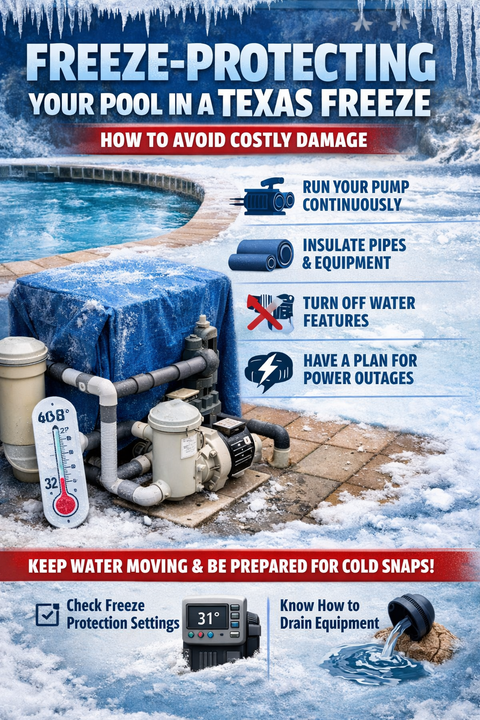
Texas freezes can show up fast—and when they do, pool equipment is often one of the first things to break. Pipes, pumps, filters, heaters, and salt systems don’t handle frozen water well. The good news: most freeze damage is preventable if you take the right steps before temperatures drop below 32°F.
Below is a clear, Texas-friendly checklist to protect your pool and equipment during a freeze.
Why Freezes Damage Pools
When water freezes, it expands. If water is trapped in plumbing lines or inside equipment, that expansion can crack:
-
PVC pipes and fittings
-
Pump housings and lids
-
Filter tanks and manifolds
-
Heater heat exchangers
-
Valves, gauges, and unions
Repairs after a hard freeze can easily cost hundreds to thousands of dollars—especially if multiple components crack.
The #1 Rule: Keep Water Moving
In most Texas freezes, the simplest and best protection is circulation.
Run the pump continuously (or at least overnight)
-
If your pool has a freeze-protection mode, make sure it’s enabled and tested ahead of time.
-
If it doesn’t, manually run the pump when temps are near freezing—especially overnight and early morning.
Why it works: moving water is far less likely to freeze than still water, and circulation keeps lines from icing up.
What pump speed should you use?
-
Single-speed pumps: run normally.
-
Variable-speed pumps: run at a higher RPM than your usual “low” setting so you get steady flow through the system (strong enough to keep water moving through all lines).
Protect Exposed Equipment and Plumbing
Even with the pump running, wind and prolonged cold can freeze exposed parts.
Cover what you can
-
Wrap exposed pipes, valves, and above-ground plumbing with pipe insulation (foam sleeves).
-
Cover equipment pad components with freeze blankets, moving blankets, or towels (keep them dry if possible).
-
In a hard freeze, add a weatherproof tarp as an outer layer to block wind.
Important: Don’t block motor ventilation. Keep any coverings away from the pump motor vents so it doesn’t overheat.
Don’t rely on “heat lamps” unless you’re careful
If you use a work light or heat source, keep it stable, away from water, and follow all safety precautions. Fire risk is real. Most homeowners are better off focusing on circulation and insulation.
Turn Off Features That Are Vulnerable
Some water features freeze faster than your main pool.
-
Waterfalls, sheer descents, deck jets, bubblers: turn them off and divert flow back to the pool returns.
-
Sprays and misters: shut down completely.
-
Automatic fillers: these can freeze and crack—consider shutting off the fill line if it’s exposed.
If you have a spa spillover, reduce or pause spillover if temps are extremely low, unless your system needs it to keep spa plumbing moving.
Use Your Valves Wisely (Pool + Spa Combos)
If you have a pool/spa combination, frozen damage often happens in spa lines because they sit idle.
-
If possible, circulate through both pool and spa lines during a hard freeze.
-
Many systems can be set to alternate between pool and spa every few hours.
-
If you’re not sure, the safe approach is continuous circulation that ensures every line gets moving water.
Salt Systems, Heaters, and Automation Tips
Salt Chlorine Generators (Salt Cells)
Most salt systems stop generating chlorine below a certain water temperature. That’s normal.
-
Let the salt system shut off if it’s designed to do so.
-
The key is still running the pump to protect plumbing and equipment.
-
After the freeze, inspect the cell for cracks and check unions for leaks.
Pool Heaters
-
Don’t run a heater just to “fight the freeze” unless you understand your setup and flow requirements.
-
In many cases, circulation is enough for typical Texas freezes.
-
If you do run heat, make sure water is flowing properly and vents aren’t obstructed.
Freeze Protection (Automation Systems)
If you have automation:
-
Confirm freeze protection is enabled
-
Confirm the temperature sensor is working
-
Verify it actually triggers the pump before the freeze hits (do a quick test)
What If Power Goes Out?
Power outages are a major risk during Texas freezes. If the pump can’t run, you may need to drain equipment and lines to prevent cracking.
If you lose power for an extended period:
-
Turn off breakers to pool equipment (safety first).
-
Open the pump lid and remove drain plugs (if accessible).
-
Drain the filter (most filters have a drain plug at the bottom).
-
Drain the heater (many have drain plugs; follow manufacturer guidance).
-
Open air relief valves on filters if you have them.
-
Set valves to open positions so water isn’t trapped.
If you’re not comfortable doing this, call a pool pro—freeze damage gets expensive quickly.
Don’t Drain Your Pool (Usually)
For most Texas cold snaps, do not drain your pool. Lowering water too far can:
-
expose plaster to cracking
-
cause structural issues
-
damage tile lines
-
create hydrostatic pressure problems (especially after heavy rain)
The exception: some extreme scenarios where a professional instructs you to partially drain or winterize lines.
Post-Freeze Checklist (The Morning After)
When temperatures rise:
-
Check around equipment for leaks or wet spots
-
Inspect pump lid, unions, valves, and filter area
-
Make sure water is flowing normally
-
Clean skimmer baskets and pump basket
-
If anything looks cracked or leaking, shut down and address it before running longer
Quick Freeze Checklist for Texas Pool Owners
If a freeze is coming tonight:
-
✅ Run the pump continuously overnight
-
✅ Disable water features and redirect returns
-
✅ Insulate exposed pipes and valves
-
✅ Confirm freeze-protection mode is enabled (if you have it)
-
✅ Keep baskets clean so flow stays strong
-
✅ Have a plan in case of a power outage (know where drain plugs are)


Comments (0)
There are no comments for this article. Be the first one to leave a message!